


The automobile industry is undergoing a fundamental transformation. Beyond performance and fuel efficiency, manufacturers are now prioritizing air quality, environmental compliance, and passenger safety. One technology enabling this shift is activated carbon, widely used across automotive air filtration, emission control, and odor management systems.
Eco-friendly, high-performance activated carbon has become an essential material for modern vehicles, supporting cleaner cabins and reduced environmental impact across the automotive value chain
Why the Automobile Industry needs Activated Carbon?
Vehicles today are exposed to a complex mix of pollutants vehicle exhaust, industrial emissions, volatile organic compounds (VOCs), and unpleasant odors. Traditional mechanical filtration alone is no longer sufficient.
Activated carbon is integrated into automotive systems because it:
• Adsorbs harmful gases and VOCs at a molecular level
• Improves in-cabin air quality for passengers
• Controls odors and toxic emissions
• Supports regulatory compliance and sustainability goals
This makes activated carbon a critical component in modern automotive filtration technologies.
Role of Activated Carbon in Automotive Air Filtration
Cabin Air Filters
Cabin air filters infused with activated carbon are designed to purify the air entering the vehicle interior. These filters remove:
• Nitrogen oxides (NOx)
• Sulfur compounds
• Hydrocarbons and VOCs
• Unpleasant external odors
Activated carbon-based cabin filters significantly improve passenger comfort and health, especially in urban and high-traffic environments
Emission Control
Activated carbon plays a key role in reducing automotive emissions by trapping fuel vapors and harmful gases before they are released into the atmosphere.
Key emission-related applications include:
• Evaporative emission control systems
• Fuel vapor adsorption
• Industrial exhaust air treatment in automotive manufacturing
By minimizing the release of toxic gases, activated carbon supports cleaner air and lower environmental impact, aligning with global emission standards.
Activated Carbon for Automobile Industry
Eco-Green’s activated carbon solutions are manufactured using sustainable raw materials, including coconut shells and natural biomass, ensuring:
• High adsorption efficiency
• Consistent particle structure
• Food-grade and industrial-grade purity
• Environmentally responsible production
Their integrated manufacturing and quality control infrastructure ensures reliable performance across powder, granular, and pelletized carbon forms.
Types of Activated Carbon Used in the Automobile Industry
| Activated Carbon Type | Automotive Application | |
|---|---|---|
| Granular Activated Carbon | Granules | Cabin air filtration |
| Pelletized Carbon | Pellets | Gas phase odor control |
| Impregnated Carbon | Treated carbon | Acid gas & VOC removal |
| Steam-Activated Carbon | High-purity | Emission control systems |
Each type is selected based on adsorption capacity, airflow resistance, and pollutant type.
Advantages of Activated Carbon in Automotive Systems
• Enhances cabin air quality
• Reduces exposure to toxic gases
• Improves passenger comfort
• Supports emission compliance
• Long service life and cost efficiency
• Sustainable and eco-friendly solution
These advantages make activated carbon indispensable in both passenger and commercial vehicles.
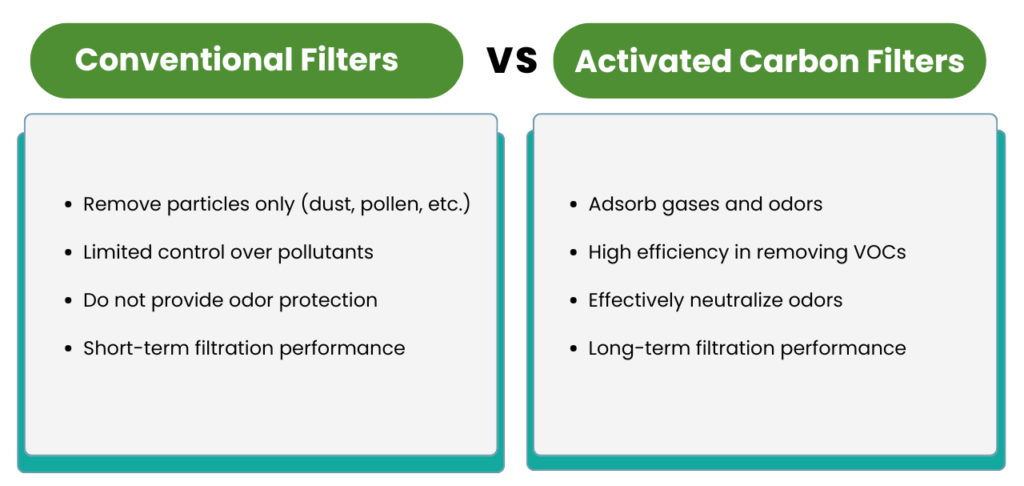
Applications Across the Automotive Value Chain
Activated carbon is widely used in:
• Cabin air filter manufacturing
• Vehicle emission control systems
• Automotive HVAC systems
• Industrial air purification in vehicle plants
• Odor and chemical vapor removal
Its versatility allows seamless integration into multiple automotive processes.
Final Thoughts about Automotive Filtration Is Activated Carbon
As the automobile industry moves toward cleaner, safer, and more sustainable mobility, activated carbon remains a cornerstone technology. Its unmatched adsorption performance, environmental benefits, and proven reliability make it the preferred solution for automotive air purification and emission control.
Manufacturers investing in high-quality activated carbon solutions are not only improving vehicle performance but also contributing to healthier environments and enhanced passenger well-being.